Hair transplants have never been more affordable. De Haar Hair Restoration has competitive pricing at approximately $ 3.50 – $ 5 CAD per graft. Each graft typically contains anywhere from between 1 to 4 hairs per graft. For our transplants other than situations when we need to re-create a fine progressive frontal hairline, we target high volume, robust grafts to optimize your results, giving you the coverage you need and saving you money. Many clinics will tell you that location is a factor in the cost of a hair transplant. They will state that hair transplant costs are higher in western Canada but with De Haar Hair Restoration, this is completely false. At De Haar Hair Restoration our hair transplant costs are lower across the board and our quality and results are significantly better due to the fact that we take the time to assess and choose robust high volume hair grafts from your donor area for transplantation. A hair transplant typically costs between $ 3000 to $ 8000. De Haar Hair Restoration has competitive pricing making our services accessible to everyone.
Are there financing options for hair transplants?
For those requiring financing, options are available. If you are interested in financing options, please mention this at your consultation and we will provide you with details at that time.
What are the phases or stages of hair growth?
Like most biological processes our hair grows in cycles. Due to the fact that we have between 90 and 150,000 hairs on our head, each follicle has its own time clock, and all hair follicles go through these same phases, only at different times. There are three phases to hair growth. The anagen phase, the catagen phase and the telogen phase. Some scientists classify hair growth in four stages, referring to the final stage as the exogen stage, but most believe that the exogen stage is the end or winding down of the telogen stage.
The Anagen phase; Individual hairs are in the anagen phase when they are actively growing. This stage can last anywhere from two to eight years. Approximately 80 to 90% of your hair is in this growing phase at any given time.
The Catagen phase; Eventually the anagen phase slows down and ends triggering the catagen phase. This phase generally lasts from 2 to 3 weeks. This is where the hair follicles shrink a bit and blood supply becomes more restricted to the follicle resulting in the separation of the hair from the base of the follicle. The separated hair does not leave the follicle at this stage but sits there.
Once a hair has separated from the base of the follicle the hair follicle goes into a resting phase until a new hair starts to form in the follicle. This is the very beginning of the telogen phase.
The Telogen phase; This phase is when a new hair starts to form in the hair follicle and in the later part of the telogen phase, the hair that was separated in the catagen phase and was sitting there, will now shed from the scalp. Losing 50 to 100 hairs per day is not unusual. The telogen phase lasts approximately 90 days.
What are the factors that determine if I am a good candidate for hair transplant?
Good general health
Sufficient donor hair density
Appropriate stage of hair loss
Scalp condition and hair characteristics
Norwood scale classification 2 or higher
Determining a good candidate for hair transplant firstly involves you being in good general health. Dr. Gerbrands will take an in-depth medical history reviewing your overall health.
A good candidate must have sufficient donor hair density. The donor hair for any hair transplant is taken from the back and sides of the scalp. This is the area where you have permanent hair. If you do not have enough donor hair you would not be a candidate for a hair transplant. Unscrupulous doctors have performed hair transplants and gone over the threshold of what is an acceptable amount of donor hair to remove, creating permanent damage that is often irreparable. This is known as overharvesting. The donor hair and in particular the donor area needs to be as equally managed as the recipient area which is the area receiving the hair graft.
A good candidate should also be of an appropriate age and in an appropriate stage of hair loss. Good candidates are those who have experienced androgenic alopecia for two or more years. Males who are in stage 2 on the Norwood scale or higher are generally good candidates.
The condition of the scalp and characteristics of the hair are considered in determining if you would be a good candidate for hair transplant. Certain physical characteristics such a scalp flexibility and hair type will impact the outcome of the hair transplant.
What is the “Norwood Scale"?
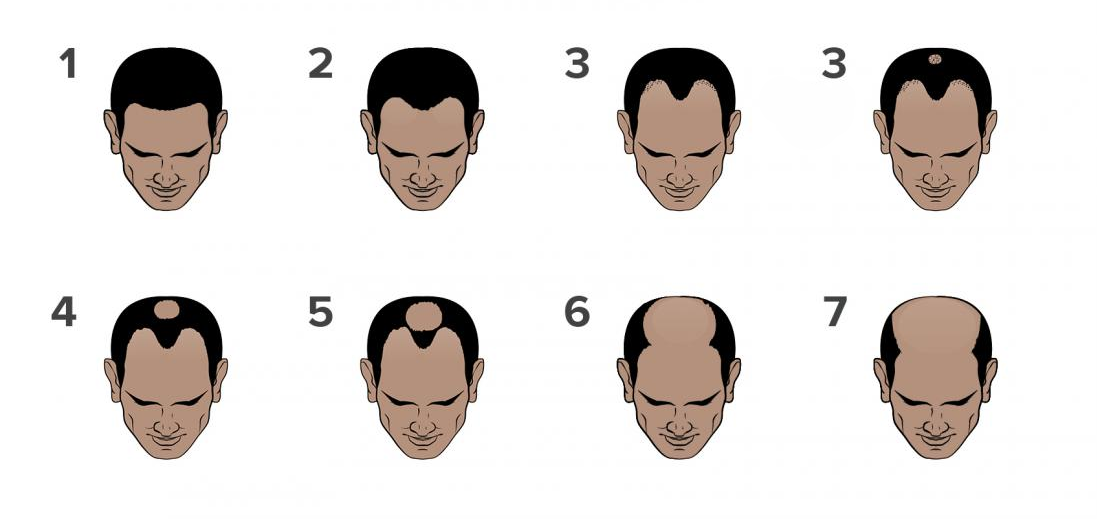
The Norwood scale was first developed by Dr. James Hamilton in the 1950s. It is a classification system used by hair loss surgeons to diagnose and predict future hair loss patterns in men who have androgenic alopecia. There are 7 stages in the Norwood scale.
Stage one; Hair loss is not significant, and your hairline is not visibly receding, but you feel a difference in the volume of your hair or perhaps notice a bit more hair in the sink.
Stage two; You may notice hair loss around your temples. This is often referred to as an adult or mature hairline and the loss of hair is not yet significantly noticeable.
Stage three; This is when your hair loss becomes obvious. The hairline recedes deeper in the temple region. Your hair is visibly thinning, and, in some cases, you also begin to lose hair in the crown.
Stage four. You will have very little to no hair on the vertex, this is the very top of the scalp. You will also have a thin band of hair across the top of the scalp that separates the balding areas and connects to both sides.
Stage five; The narrow band of hair separating your temples and the crown of your head has become thinner, and the loss of hair is significantly noticeable.
Stage six; The thin band that separated the areas of loss is completely gone. Almost all the hair on top of your head is either completely gone or extremely sparse.
Stage seven; The only hair remaining on your head is a band of permanent hair which wraps around the sides and back of the head. Any remaining hairs on top of the head or in areas other than this band are thin and sparse. This remaining band of hair is what is referred to as permanent hair. In hair transplantation terms it is referred to as the donor area.
Norwood Scale Graphic Depicting Stages of Hair Loss in Men
I see many online companies advertising prescriptions and products for hair loss. What medications do they use and how do they compare to Propecia and Rogaine?
Online companies only prescribe the more common medications similar to what you can receive from a doctor or from online stores like Amazon such as minoxidil, finasteride, a variety of shampoos and other topical medications.
Many patients have common prescriptions which when expired, have provided opportunity for companies to push their own generic versions through renewals. These online companies may allow people to get prescriptions without seeing a doctor and although convenient, this does not replace the value in receiving an in person, in depth evaluation from an experienced hair loss surgeon who specializes in diagnosing and treating hair loss. A hair loss surgeon specializing in transplantation and diagnostics can offer a wider variety of proven treatment options.
After determining the cause of your hair loss, Dr Gerbrands not only ensures that you are receiving the appropriate treatment but also has the tools to give you the evidence of measurable results.
Making sure the diagnosis is correct will allow the doctor to prescribe the appropriate dose or treatment that gives you the best chance of regrowing your hair and preventing future hair loss.
Will my hair transplant be permanent?
Yes, hair transplantation is the only permanent solution to hair loss. Although there are medications and therapies that will help you keep the hair that you have currently and even regrow some hair, these therapies require lifelong commitments and once stopped, all benefits are lost and your hair will revert back, falling into your original balding pattern. Hair transplantation is the only solution that does not require a specific maintenance regime. You would simply wash your hair as normal and go about your day.
Will my hair transplant be noticeable?
Your hair transplant will look absolutely natural and as though you have never lost your hair to begin with. This is where doctor Gerbrands artistry and skill comes in. Her expertise in the recreation of hair lines and in performing hair transplants, including of the beard and eyebrows is unmatched. The lack of the ability of those around you to detect that you have had a transplant is a testament to this.
How long until I see the results from my hair transplant?
After your hair transplant you may notice that some of the hairs in the transplanted follicles will fall out and this is perfectly normal, not to worry, that follicle is still alive, and a new hair will be produced by that very same follicle. Hair growth can start sometimes as early as the 3rd to 4th month. At this stage it is very important not to scratch your head, it may be itchy. This itchiness is a sign that hair is starting to grow. Between 6 to 9 months after your surgery, the hair growth is now showing significantly and by 12 to 14 months the results are complete although on some occasions some patients will still regenerate new hair from follicles for up to 18 months. These hairs growing from the transplanted follicles are permanent
Which is better: FUE or Robotic FUE?
In deciding which method of hair transplantation is best between manual or robotic FUE there are many considerations. Robotic FUE is highly dependent on the skill of the operator as well as other factors which include the treatment of the hair graft after removal from the donor area of the scalp and prior to implantation into the recipient area of the scalp. Direction of the follicular root, skin laxity, blood supply and healing potential of the patient.
What is the most important factor in a successful hair transplant?
Regardless of which method is used, the skill of the surgeon is key. The expertise of the surgeon in analyzing the patient’s scalp conditions, donor area parameters, recipient area and hair follicles allows them to recommend the appropriate method that is best suited for you, and that which will provide you with the best outcome.
What kind of scar will I have from FUT strip surgery?
The extraction of the strip of skin containing the donor hair follicles does leave a linear scar. The length is determined by the size of the strip removed, however in the hands of a skilled surgeon this scar is very thin and is easily covered by surrounding hair, so it is not detectable. If someone wishes to wear a completely shaved head this tiny scar can be revised using SMP making it virtually undetectable even at close range. It is important that you follow all the instructions provided by doctor Gerbrands in your post procedure instructions to minimize any risk of infection.
The FUE harvesting process takes longer. In performing FUE, Dr Gerbrands will assess each individual graft and its direction before removal thereby allowing the harvest of only the most robust grafts. In FUE, the surgeon can easily compensate for individual nuances such as the direction of the follicular bulb.
When will I be able to wash my hair after my procedure?
Yes, you will receive your first hair wash the day after your procedure at De Haar Hair Restoration Clinic and be given instructions as to washing and caring for your scalp and hair.
What is Robotic FUE?
Artas robotic system is a high-tech tool that utilizes image guided technology in the process of harvesting individual hair grafts from the scalp for placement into a recipient area of the scalp. It is an assistive tool used by the surgeon enabling the removal of thousands of grafts in a short period of time.
Robotic FUE is best performed on patients that have straight hair where the angle of the follicle is similar throughout the area that is being harvested. In the hands of a skilled surgeon this method can result in faster procedures but faster is not always better.
Do I need to shave my hair for Robotic FUE?
It is recommended that the hair is shortened to the optimal length of 1 mm prior to the procedure. This can be done in the hair transplant surgeons office but not all surgeons will provide this service.
What is the recovery time for an FUE hair transplant?
FUE is a minimally invasive procedure with very little downtime. You will have some very small scabbing on the donor area of your scalp that will fall off in 5-7 days. In 2-3 days, you can return to your normal activities and Dr Gerbrands will provide you with instructions on washing your hair and caring for it in your post-procedure instructions.
Is FUE a scarless surgery?
FUE is often called a scarless surgery but in fact FUE will leave tiny white dots. These are the individual, minute scars from where the hair follicles were removed. The surrounding hair, even at short lengths, makes it virtually undetectable. If you were to have a completely shaved head, in some instances these little dots may show but this can be easily camouflaged with the use of SMP or simply having the hair at a bit longer length.
How long is the recovery from my FUT hair transplant?
The recovery time for an FUT procedure is generally 7 to 10 days.
How does Dr. Gerbrands measure the amount of donor hair I have?
De Haar Hair Restoration has a trichoscopy lab, and computerised equipment in her office which she will utilize to measure the precise amount of hair you have over the various regions of your scalp.
What are the characteristics of female hair loss?
Androgenic alopecia in women is referred to as female pattern hair loss. Female pattern hair loss is characterized by the widening of the part at the crown of the head. It is always best to institute therapy before significant hair loss has occurred.
What classification system is used in female pattern hair loss?
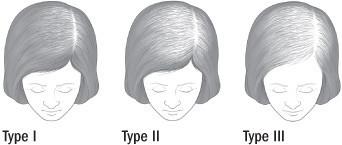
The Ludwig scale is a system used to measure the degree of female hair loss.
What is the Ludwig scale and what are the stages?
Hair Loss in Women for the most part, presents differently than in males. The stages of the Ludwig scale are depicted here.
Halting the progression of hair loss in women has been achieved for some time now, and until recently improvements in hair density were more limited. With advanced technologies and pharmaceuticals this is no longer the case. Your hair density can be significantly restored allowing you to wear your hair as you like and restoring your confidence at the same time.
How will I know if my hair loss treatments are working?
In the majority of cases, given the appropriate treatment response time, your results will be obvious. When assessing if a treatment is working and to what degree, Dr Gerbrands may utilize specialized state of the art instruments and trichoscopy to measure the volume of hair including its diameter and tensile strength. She will also assess the health of the hair, including the scalp and follicles.